
Navigating Career Transitions with AI & Technology
Technology is Rewriting the Career Playbook
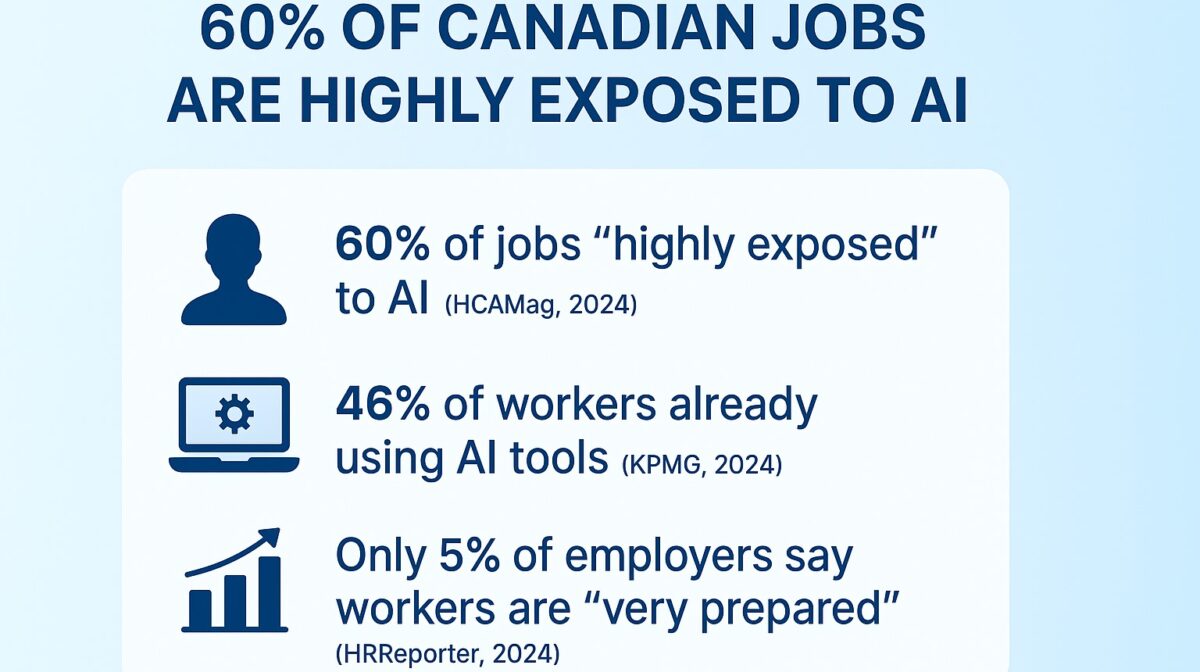
Whether you’re thinking about a job change, moving into a new field, or simply adapting within your current role, technology especially Artificial Intelligence (AI) is no longer optional. In fact, around 60 % of Canadian jobs may be “highly exposed” to AI meaning many roles will evolve significantly. (HCAMag) It’s not a straightforward threat of elimination, but a clear signal that tasks and careers will look different.
What the Data Tells Us
In Canada, nearly half (47 %) of employed adults worry that AI and automation could force them to change jobs or careers in the near future. (Abacus Data) At the same time, adoption of generative AI in workplaces is skyrocketing for example, a survey found that 46 % of Canadian workers are now using generative AI in their jobs (up from 22 % the year before). (KPMG) Yet, despite this rapid uptake, only 5 % of employers say their workers are “very prepared” to use AI. (Canadian HR Reporter) The mismatch is clear: high exposure, fast tech change, but lagging readiness and skills.
Turning Disruption into Opportunity
Here’s the silver lining: AI doesn’t just take away tasks it transforms them, and opens doors. Research shows that jobs where humans collaborate with AI (rather than compete with it) tend to benefit most. (arXiv) For professionals navigating a transition, this means the focus isn’t just on switching jobs it’s on upskilling, reskilling and embracing the “augmented worker” concept.
For example, platforms and tools can now analyse your work history and surface transferable skills by the hundreds one study found AI-tools detected up to 93 % of relevant skills and helped people land new roles faster. (Acedit)
Practical Steps for Your Career Shift
- Audit your current skill-set: Which tasks are already being automated? Which tasks are becoming more strategic?
- Identify AI-adjacent capabilities: Critical thinking, relationship building, ethics, digital literacy these are the skills that complement AI, not compete with it. (arXiv)
- Choose roles built for the future: Seek career pathways that blend technology + human skills.
- Use technology to your advantage: Try AI tools for reflection (resume analysis, skills mapping), not just automation.
- Build your learning flexibly: With new credentials, micro-courses, and on-the-job experience. For example, Canadian businesses reported an estimated C$111 billion annual loss due to automation-related career transitions and skills gaps which points to the value of being proactive. (Newswire)
The Takeaway
The bottom line: If you’re navigating a career transition, don’t fight AI partner with it. Recognise where change is happening, pivot your mindset from task-based to capability-based, and leverage technology to help you find the next move. For those willing to adapt, this is a moment of exceptional opportunity.